Table of Contents
Congo
“The frozen Congo does not belong to men. Men are tolerated by it.”
Congo is not a nation shaped by borders or crowns. It is a living dominion ruled by shard-awakened simian clans who have held the northern wilds of Africa since the world broke. Beneath black spruce forests, glacial valleys, and wind-carved tundra, the Great Apes rule by strength, memory, and instinct refined into law. The land itself is their capital, their fortress, and their witness.
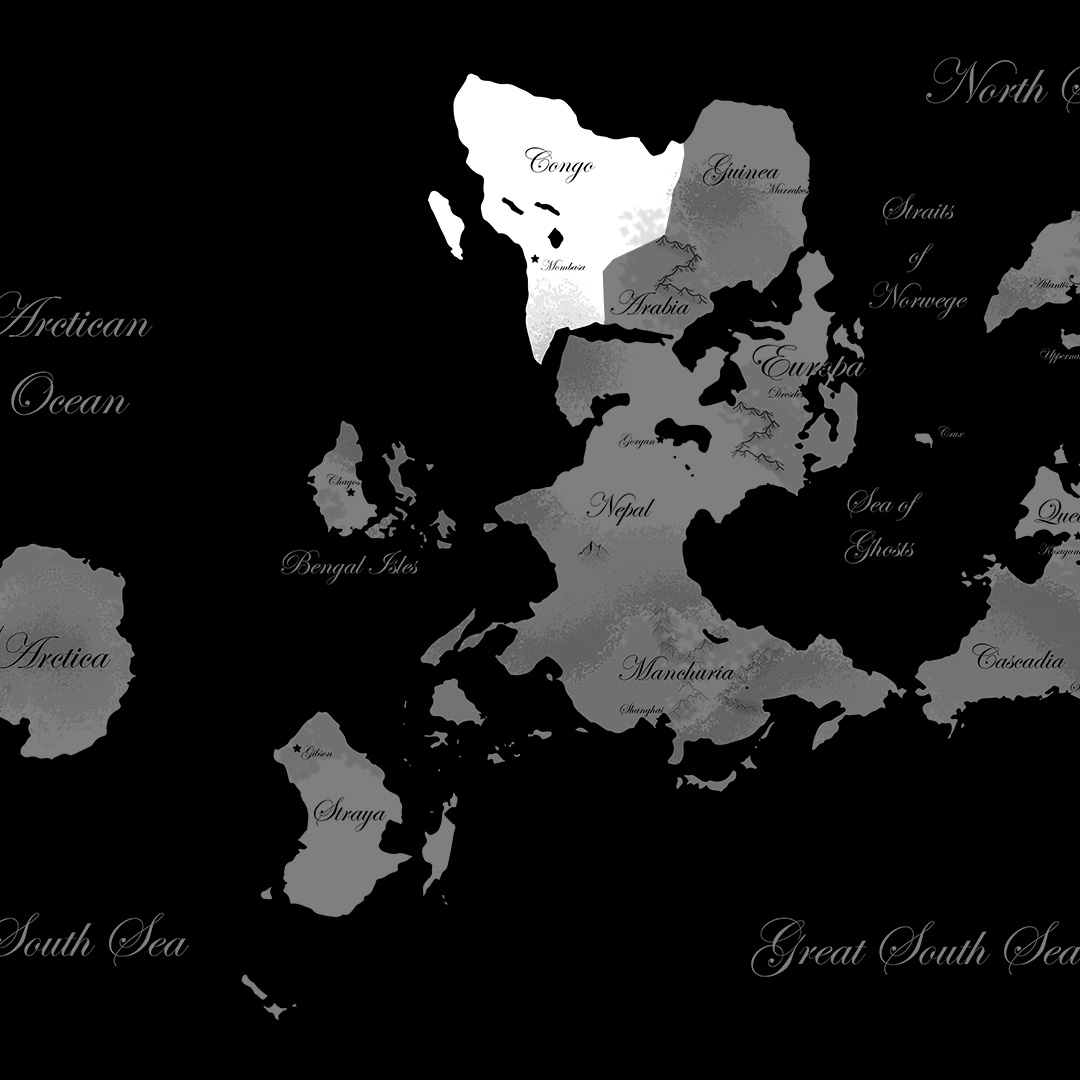
To outsiders, Congo appears savage and impenetrable. Expeditions vanish into snow-laden forests. Columns collapse without battle. Maps end abruptly at its frozen margins. Yet this appearance hides a sophisticated web of alliances, rituals, and long memory. The clans know every ridgeline, every frozen river, every place where the land itself listens. Congo does not repel invasion through walls or armies. It lets the cold, distance, and patience do the work.
No foreign power has ever conquered the Congo. Those who tried learned quickly that the land does not need defending. It only needs time. Congo trades only what it chooses to give. Frostbone carvings, aurora dyes, cured mammoth, rendered tallow, and shard-pulsing drum hearts are prized by artificers and scholars alike. In return, the clans accept medicines, salt, woven cloth, and steel tools. Firearms and ammunition are coveted, not for conquest, but for balance.
Adventurers who enter Congo without invitation rarely leave. Those who do are changed. They learn quickly that the clans do not see themselves as rulers of the land. They see themselves as its voice.
The Simian Confederations
Congo has no king and no capital. Authority rests with tribal confederations bound by oath, territory, and shared survival. Each clan governs itself through councils of chieftains, elders, hunters, and ritualists known as Shardspeakers, who interpret shard resonance through bone drums, scar patterns, and the cracking of ice.
Power is localized, but unity comes swiftly when the land is threatened. Disputes between clans are common and ritualized. Disputes with outsiders are brief and final.
Law is oral and absolute. Kin must be honored. Territory must be guarded. The land must not be scarred for greed. Justice is communal and public. Punishment is swift. Repeat violators are not imprisoned. They are driven north into the Desolation and forgotten.
Congo sends no diplomats and hosts few emissaries. Its sovereignty is acknowledged across Africa not by treaty, but by fear of consequence.
The Quiet Line
The boundary of Congo is known as the Quiet Line. It is not marked by walls, but by cairns of stone, ice, and bone carved with clan glyphs and smeared with resin and shard-dust. Traders may approach the cairns. Few are invited beyond them.
The treaty governing the Quiet Line is simple. No forts. No mines. No missionaries. In return, the clans permit seasonal markets at designated sites and pursue raiders who violate the boundary, even when those violations are benign.
Those who break the Line often vanish. Sometimes their marked skulls appear months later atop the cairns with a single word carved across the brow: PAID.
Land and Beasts
Congo’s taiga and tundra are vast beyond human scale. Forests stretch unbroken for hundreds of miles. Rivers freeze solid in winter, becoming roads for those who know how to read the ice. Shardisite veins warm pockets of permafrost, creating crystal-thaw basins where fog crawls even in deep cold.
The megafauna are legends made flesh. Mammoths with fractured crystal tusks. Glass-maned lions whose frozen coats chime when they breathe. Shard-veined gazelle herds that can slice caravans apart in their stampede. Hunters learn quickly that survival here depends on reading the land, not mastering it.
At the frozen heart of Congo, outsiders whisper of something vast and ancient beneath the ice. Some call it a god. Others claim it is the beating heart of the Earth itself.
Places of Note
| Location | Summary |
|---|---|
| Lake Victoria Cairn | The largest treaty market along the Quiet Line. Five major clans gather here during winter courts. Traders hang banners from ice-set poles and disputes are settled in rings of drums on frozen ground. |
| Drum-Caves of Limpopo | Subglacial chambers where shard-veined stone resonates like a heartbeat. Initiates spend three nights in darkness to learn the rhythm of ice and earth. |
| The Ghost-Forge | An abandoned railway refinery half-buried in ice and spruce. The clans forbid approach. Locals speak of metallic grinding beneath the snow. |
| The Red Canopy | A dense spruce highland stained by iron-rich frost and constant aurora glow. Warring clans and colossal beasts rule its shadowed paths. |
Faith and Memory
The Choir & The Legion are acknowledged but distant concepts in Congo. The clans honor ancestral totems, spirits of loved ones impressed into shards at the moment of their death, and a land spirit they call The Great Mother. Belief here is not seen as summoning divinity, but as amplifying what already breathes within the world.
Angelic worship is tolerated if they keep to the cairns and to themselves. Demonic pacts and acolytes draw blood on sight.