Ballad of the Blissful Malady
Featured in The Copper Press, 27 February, 2158 A.M.
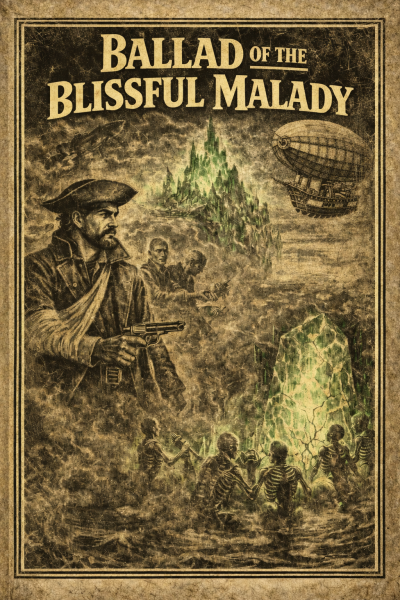
Crimson Sails at Dawn
They say the Sea of Ghosts never sleeps. Its waves claw ice from shattered bergs and hurl it skyward on updrafts so cold they ring like chimes against an airship’s hull. Perfect hunting ground for a privateer who isn’t afraid of frost or phantoms.
My name is Captain Ryan Mallory, skipper of the free cutter Blissful Malady. We found ourselves three hundred miles deep above the Caribbean Straits, chasing a fat ore-runner called the Laurelai out of Hartemple. Her hold was brimming with unrefined Shardisite and it was enough to buy my crew wages a hundred times over.
Dogfights in thin air feel more like a knife duels than a naval battle. You close fast, trade some shot, then try and keep pace as you lash hulls for boarding. My Malady was smaller, nimbler, and my gunner; a stout man named Saul Proudstone, could thread cannonballs through a chimney flue. Within minutes we shaved the Laurelai's gas bladder, venting noxious hydrogas in a gout of purple mist. She could either jettison cargo or sink into brine. Her captain chose the former. Crates shattering across the sea below like confetti.
Victory, however, arrived wedded to ruin. The ore-runner’s last shot wasn’t at our bladders but at our starboard crew rail where Saul stood roping a boarding line. One grapeshot quarrel took his head and half the deck watch. Another ripped the ballonet feed, venting our main gas reserve.
We still won. The Laurelai spiraled down in flames but the Malady staggered wounded. Shrapnel had stitched the crew. By the time we cut free, only three hands besides me remained alive and two would bleed out before nightfall.
Adrift on the Wind
The Sea of Ghosts rewarded our gambit with isolation. Clouds here are so dense with frozen spray they muffle engine roar. After the smoke cleared I could hear my own heartbeat ticking like a metronome inside my ears.
Damage report: Elevation cell torn; fuel tanks holed; wind vane sheared clean. Food stores soaked in hydrogas. Fresh water down to half a keg. Crew: one. Myself.
I set bones in splints. My left arm hung useless from its socket but adrenaline dulls pain. I patched the gas cell with canvas tar and candle wax. Enough to hold altitude at reduced speed. Still, the compass spun madly. Shardstorms below scrambled magnetics like a drunk shuffles cards. Without dead-reckoning stars, I could drift halfway to Europa.
Twice I thought I glimpsed other hulls through cloud breaks. Pale silhouettes trailing dim green light. Salvagers, perhaps, or the rumored Ghost Regiment ships that tether derelicts for scrap. My signal lamps were smashed, and firing a gun would only invite predators.
Hunger and Shard Dreams
Three days the wind carried me westward. At least by sun-arc guess. Rations dwindled to crumbs. Sleep came fitful, haunted by hammering sounds below deck. When I investigated, nothing but cargo chains creaking. Yet each night the hammering grew louder, until I recognized the rhythm: old Saul’s old cadence for loading shot. Dead men keeping watch.
Shardisite dust from burst crates coated every railing in a green frost. Breathing it seeds visions they say. I scoffed at such tales, until moonrise of the fifth night when the Malady’s wheel spun without my touch. It lined the ship toward a tear in the clouds, revealing black water below threaded by luminescent veins. In that glow floated fragments of my fallen enemy’s cargo: Shard-crystals bobbing like lanterns on the swell, singing just beyond hearing.
A man adrift with no crew begins bargaining with delirium. I considered diving; opening the ballast valves, spiral down, fetch the crystals. Their power might refill my fuel cells. Or burst them. Or burst me. I lashed the wheel down and crawled away.
Ghostlights at the Gunwale
Storm clouds bruised the horizon purple. Inside the squall flickered witch-fire. The kind that crawls over metal and sets hair on edge before frying nerves. No ballast or rudder could turn the Malady in time. I secured every stray rope, doused lanterns, strapped myself to the helm post.
The squall hit like a storm elemental. Sheets of horizontal hail blasted canvas. Wild arcs of green lightning danced over brass fixtures, illuminating the deck in strobing emerald. In each flash I saw crewmen where none lived: Saul loading the port cannon; Eli patching the sails; young Mira at the lookout nest singing a dirge. They looked at me accusatorily asking; “Why am I dead?”, “Was it worth it?” then vanishing when darkness returned.
Lightning struck the fore-mast, splintering it into a flaming javelin that toppled overboard. The sudden loss of forward rigging yawed the hull; I slammed into helm spokes, snapping two ribs. Pain flared white hot, but the ship steadied on a lingering updraft and it became dead calm inside the storm’s eye.
There, silence reigned so complete I could hear sleet hiss on my eyelashes. Ahead lay something impossible: an iceberg fortress adrift on cloud, lifted by an unknown arcana venting bleeding from its fissures. Spires of sapphire ice reflected starlight that should have been hidden by storm. Anchored to its flank: a skeletal barque riddled with hole-eaten sails. An older casualty of these skies. Refuge or grave?
Choices Cut from Frost
Proximity wards warned that the Malady would tumble if I tried to moor against that berg. But supplies were gone, wounds festered, and the boiler hissed on empty. I spooled anchor chains and drifted closer until metal scraped ice. Then I leapt.
An icy cold bit through my boots like knives. I hauled a tether line, cinched it around an ice spire, and prayed the hull wouldn’t sheer away. The berg’s surface was riddled with tunnels. I could feel a warm air drift from them, scented faintly of salt and ozone. I I followed the largest passage downward, revolver drawn.
Inside, blue corridors opened into a cavern lit by shardisite crystals bigger than a closed fist. In their glow lay skeletons in merchant coats. The crew of the derelict I thought. Some knelt in a prayer posture before a single giant crystal at chamber center. On its face was carved a sigil unknown to me. Half-angelic, half-mathematical. Beneath it lay a booklet waterproofed in wax. The script was Nepalese trader-cant, but one phrase repeated: OUR CHORUS IS STRAINED. NEED ONE MORE VOICE.
A choir stone. Raw shardisite honed to manifest lift. The dead must have tried to sing themselves skyward and failed. My throat, cracked from thirst, felt suddenly too narrow. If I could tune that crystal, bleed a scrap of melody, maybe I could refill the Malady’s cells and steer home.
But the walls whispered. Each shadow gnawed at corners of sight. I knew this was the cusp where ambition becomes tomb. Still, I was already a ghost if I stayed adrift.
The Song of Broken Ribs
I tore fabric from my coat to fashion a crude sling for ribs, steadied my breath, and stepped to the crystal. Its surface thrummed against my palm, mapping my heartbeat. I matched its tempo and hummed a dirge Mira once sang at breakfast. Her notes resonated within the crystal, climbing in pitch and harmony until the air itself shivered. Ice trembled loose from ceiling, tinkling like bells as they skittered at my feet.
Light bloomed inside the shardisite. At first emerald, then gold, then a pure white that bleached every surface with blinding brilliance. It spilled over skeletons, coating them in quicksilver that forced them into Mira's song. Their jaws opened, joining in this macabre harmony. A choir of bone and ice around centered around a lone living soul.
I should have stopped. Instead I reached for crescendo. Pain vanished; cold turned warm. I swear I felt the soul of the Malady outside, cells swelling, seams groaning as lift flooded in. In my mind I could see the ship rise, snatching her anchor free. Her lines whipped taut, but I kept singing.
The berg lurched, pulled upward by Mira's song. Cracks spidered through its ice. Skeletons crumbled to dust, their voices dropping out of the chorus one-by-one, leaving me solo in a song too large. The pitch warped and waned as the crystal flashed a chromatic warning.
I cut the tether. The line hissed skyward as the Malady cleared the berg. Without external focus, the crystal stuttered, then exploded in violent shards of untamed arcana. The shockwave blasted me onto slope of ice. I slid, bounced off a ridge, and tumbled into freefall.
The roaring wind tore the screams from my lungs until a massive dark savior swept beneath me. The Malady, acting of her own accord and seemingly not want to see her captain waylaid to the winds. The Malady caught me like a mother catching a wayward child. Rough, but alive. I hauled myself over the rail with the last of my strength.
Home Is a Line on the Horizon
Dawn stained clouds rose. The Malady floated steady on what remained of its sails, cells humming with fresh lift. Her fuel gauge still read empty, but the Shard chorus carried me regardless. Singing faintly from the patched envelope. I lashed the wheel toward the western horizon, chasing the hope of a Europan trade lane.
Days blurred. I drank melted hail, ate leather belts boiled soft, and talked to ghosts until their answers sounded like my own regrets. On the twelfth sunrise a Cruxian patrol frigate spotted my drifting hulk and took me aboard. Their doctor said my fever kept me rambling for a week about an icy choir and my skeleton singers.
They found no crew, no salvage. Only an airship hull light as a cloud, its hydrogas infused with something they couldn't measure. The Malady rests now in an Atlantian drydock, too dangerous to dissect, too wondrous to scrap.
As for me; they call me Captain “Dirge” Mallory. Some nights I wake to the sound of hammering shot or Mira singing in the crow's nest. The Sea of Ghosts took my crew, but left their echo inside my bones. I carry them like ballast, and my home is still in the sky.