The American Foreverwar
“One land, two belligerents, no victory.”
The American Foreverwar is the defining conflict of the Modern Era. It began in 1651 A.M. as a territorial war over Dixie, then spiraled into a continent-wide engine of attrition that now stains most of eastern West America and reaches into every corner of East America.
It has no clean declaration anyone still agrees on, no treaty anyone believes would hold, and no victory condition either side can name without lying. The war persists because it has become infrastructure: an unsanctioned testing ground for experimental arcanotech, a global market for weapons and Shardisite-fueled logistics, and the single most horrific tradition left to the nations that cannot imagine themselves without it.
In common speech it is called a “foreverwar” because it outlived memory. In practice, it continues because ending it would collapse the systems built to sustain it.
Origins of the War
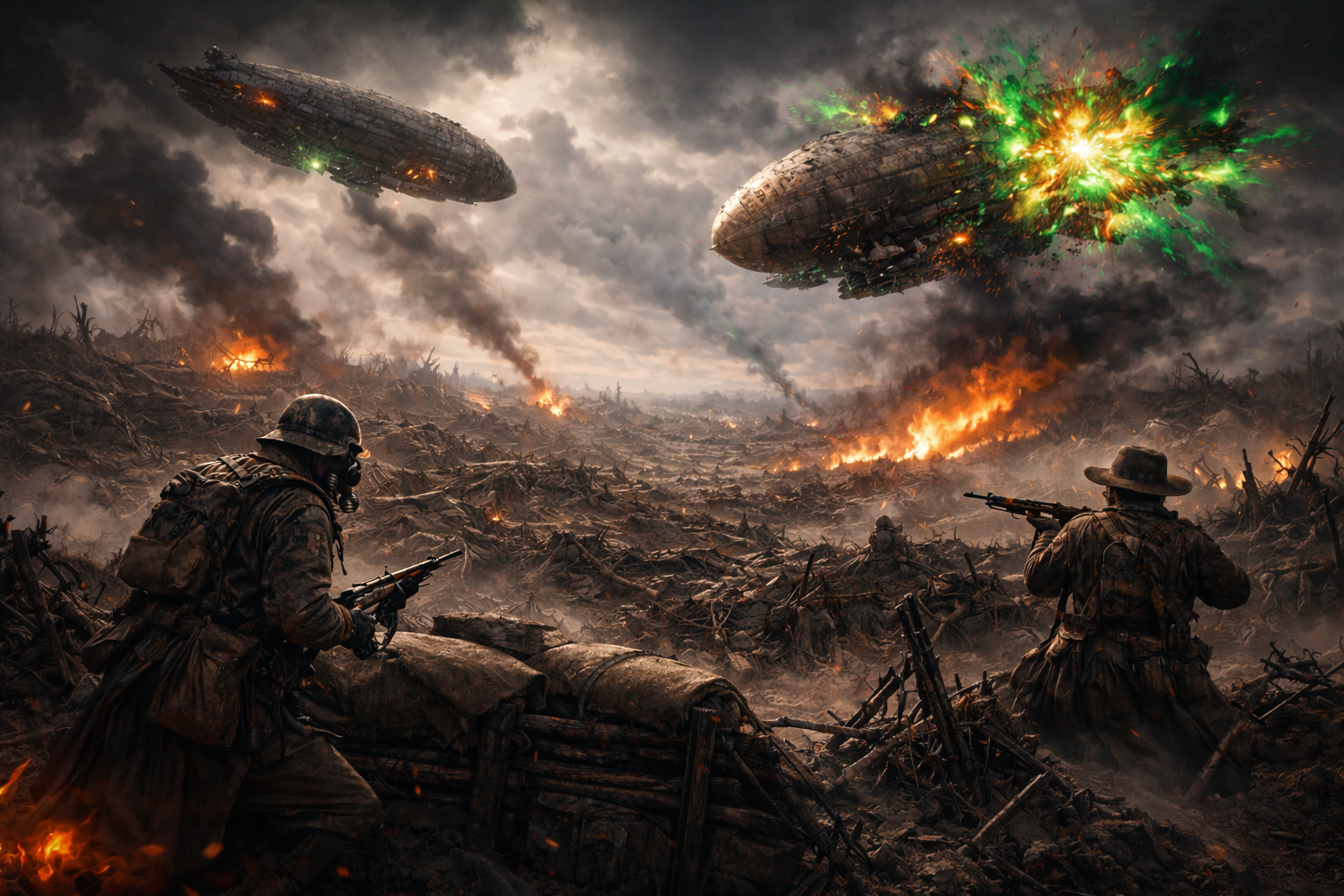 In 1651 A.M., Dixie was a young West American nation with nearly undefined borders, contested ports, and resources valuable enough to invite foreign claims. The only two nations of East America, Amazonia and Cordoba, pressed those claims in the same generation, each insisting they were acting to secure stability, protect trade, and prevent the other from taking the region first.
The first years were fought as limited campaigns and skirmishes. The next centuries were fought as habit and feud. The Foreverwar is not a single front. It is a layered disaster.
- Dixie remains the primary killing ground, contested by shifting occupation lines, proxy rulers, and constant raids.
- Eastern West America is scarred outward from Dixie as supply corridors, refugee flows, sabotage routes, and secondary fronts expand and collapse.
- East America is not spared. As the war aged, it bled back into both homelands through airship strikes, coastal bombardments, deep-penetration raids, and internal security campaigns meant to instigate collapse rather than win ground.
Neither side fights for conquest anymore. They fight to prevent the humiliation of stopping.
The Conflict as it Stands Today
The Foreverwar is defined by:
- Shifting fronts that advance by miles, then retreat by the same miles
- Long attritional stalemates broken by brief, brutal offensives
- Airship duels and shard-fueled engines that turn skies into battlegrounds and the earth below into gravefields
- Proxy mercenaries, corporate militias, and hired specialists used to patch manpower gaps and take the fight to places the nations would never admit.
- Weaponized pollution, alchemical residue, and long-lived contamination that outlasts any battle
- Total disregard for civilian life, infrastructure, and the idea of “reconstruction”
Entire cities have been reduced to salvage districts and sealed enclaves. Rivers run black. Fields are cratered and fallow. Fortresses are rebuilt on top of older fortresses until the ground beneath them becomes indistinguishable from layered graves.
Belligerents and Participants
Dixie, the Wound
Dixie took the brunt of the devastation and remains the clearest proof that the war cannot be “won.”
In the modern era, Dixie is a patchwork of:
- Ghost cities and bombed-out skylines
- Thousands of square miles of devastated wasteland
- Cratered farmland and poisoned waterways
- Mutant warbands, displaced refugees, and militia fiefdoms
- Trench networks, fortress belts, and conflict zones that never cool
Savannah endures as a survivor-capital: a market city that does not rule, but does not die. It is where scrap becomes currency, alliances form daily, and banners are treated as invitations to be shot. Where Cascadia and Quebec enforce borders with steel and spell, Dixie bleeds beyond those lines anyway, carried by refugees, smugglers, deserters, and the war's endless appetite.
Amazonia
Amazonia is a kingdom at war in the oldest sense of the phrase. It maintains monarchy, pageantry, and banners, but the war is its true government. Logistics, officer corps, and contracts signed in blood carry more weight than courtly decrees.
Amazonian regiments are known for deep blue coats and rigid discipline. Conscription is common. Desertion is punished harshly. To retire is rare enough to become its own kind of legend.
Its capital, Petrolina, remains grand in appearance and exhausted in truth. Behind parades and banners are rationing, debt, and factions that profit from the war they publicly mourn.
Cordoba
Cordoba is a fortress-state that promises survival through endurance rather than prosperity. It is ruled by a military dictatorship led by the Chancellor-General and enforced by a permanent junta. Civil governance collapsed long ago and was replaced by command structures optimized for siege, attrition, and internal control.
Martial law is absolute. Travel is regulated. Communication is monitored. Entire neighborhoods may be relocated if deemed tactically inconvenient. Cordoba does not claim divine favor. It claims necessity, and it will crush anything that threatens the machinery of continuing.
Cordoba hoards shardisite, counts it, rations it, and burns it with brutal efficiency. Airship hearts are coveted targets, and sabotage operations are often measured in acceptable suicides rather than acceptable losses.
The World’s Testing Ground
By the modern era, the Foreverwar is more than a regional conflict. It is the primary arcanotech proving ground on Earth.
Nations far removed from the trenches supply the war from all sides to keep their own industries alive. Foreign weapons, credit, and hired specialists prop up armies that can no longer sustain themselves cleanly. Technologies that would be unthinkable in peacetime are fielded here first, then sold elsewhere once proven.
The result is a war that produces invention as efficiently as it produces corpses.
Divine Interference
The divine have little place in the motivations of the belligerents. The war is fueled by politics, identity, greed, and institutional survival, not doctrine.
When the divine appear in the Foreverwar, it is rarely aligned and never predictable. Moments of mercy or spite are personal, localized, and often miraculous in the rawest sense: events survivors argue about for decades, and which armies attempt to weaponize without ever truly controlling.
Current Status
In approximately 2100 A.M., the Foreverwar no longer seeks victory. It seeks continuity.
Fronts still shift. Airships still fall. Regiments still vanish into wastes reclaimed by neither side. The only stable truth is that the war is now an identity problem for both nations. To end it would be to admit that centuries of sacrifice achieved nothing, and neither state believes it can survive that admission.
Dixie remains totally ravaged, a living monument to what happens when a nation becomes a battlefield for long enough that no one remembers it was ever meant to be anything else.
Legacy
The American Foreverwar has:
- Defined the modern era’s politics, trade, and technological development
- Enabled the rise of corporate militaries and mercenary states as normal instruments of policy
- Fed a global arms economy tied to shardisite-fueled logistics and arcanotech escalation
- Mutated populations, landscapes, and institutions beyond any promise of “rebuilding”
- Trained entire civilizations to treat peace as a dangerous fantasy